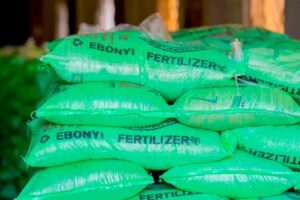
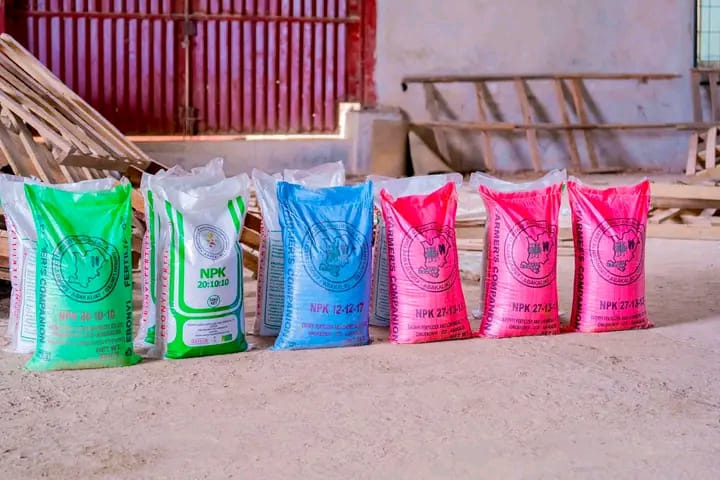
The revival of the Ebonyi State Fertilizer and Chemical Company Limited is more than the sight of bags of fertilizer stacked in warehouses awaiting distribution. Behind every bag is a carefully managed production process involving the sourcing, formulation, blending and quality control of essential agricultural inputs.
Understanding what goes into the fertilizer produced by the company provides a clearer picture of the significance of the state government’s decision to restore the facility to active production.
Four Formulations, Four Agricultural Purposes
The company currently produces four NPK formulations, each designed to meet different agricultural needs.
The first is NPK 20-10-10, a general-purpose fertilizer suitable for a wide range of crops. The figures represent the percentage composition of nitrogen, phosphate and potash respectively.
The second formulation, NPK 27-13-13, has a higher nutrient profile. According to the company’s Director-General, Dr. Sunday Nwangele, the formulation is particularly useful for farmers requiring additional nutrient support, including those engaged in swamp farming.
The company also produces NPK 12-12-17, which its production team says is particularly suited to tuber crops such as yam, potato and cassava.
The fourth formulation, NPK 15-15-15, contains equal proportions of nitrogen, phosphate and potash, making it a balanced option for a broad range of agricultural applications.
The Raw Materials Behind the Fertilizer
The production of NPK fertilizer involves more than simply mixing different materials. The Ebonyi plant uses four major raw materials: urea, diammonium phosphate (DAP), muriate of potash (MOP) and limestone.
Urea provides nitrogen, DAP supplies phosphorus, while MOP provides potassium. Limestone serves as a filler and soil-friendly component in the formulation.
The quality of these raw materials is important because the consistency and effectiveness of the finished fertilizer depend significantly on the quality of the constituent materials.
According to Dr. Nwangele, the company sources urea from approved distributors, including major Nigerian producers such as Dangote and Indorama in Port Harcourt. The granulated limestone used in production is sourced from Kano and Kogi States.
DAP and MOP are subject to Federal Government regulatory controls because of the security and handling requirements associated with certain fertilizer inputs.
From Raw Materials to the Farm
The journey of an Ebonyi-produced fertilizer bag begins with the sourcing of raw materials and continues through processing, formulation and blending.
After production, the fertilizer undergoes quality-control checks before being packaged and distributed to farmers.
The process can therefore be viewed as a complete chain: sourcing, production, quality control, packaging and distribution.
This is one of the major implications of the revival of the state-owned fertilizer company. Ebonyi State is not merely distributing agricultural inputs; it is participating directly in their production.
Supporting Ebonyi’s Agricultural Agenda
The development aligns with the administration of Governor Francis Ogbonna Nwifuru’s broader agricultural policy under The People’s Charter of Needs, where agriculture occupies the third position on the administration’s development agenda.
The objective is to strengthen agricultural production by ensuring that farmers have improved access to essential inputs needed to increase productivity and yields.
With the fertilizer plant back in production, the state is seeking to strengthen the link between agricultural input production and the farmers who depend on those inputs.
For Ebonyi’s farmers, the significance of the revived plant therefore goes beyond the bags of fertilizer leaving the factory. It represents an effort to build a more integrated agricultural support system—one in which the state participates in producing, quality-assuring and distributing inputs needed to keep its agricultural sector productive.