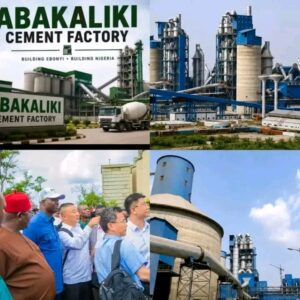
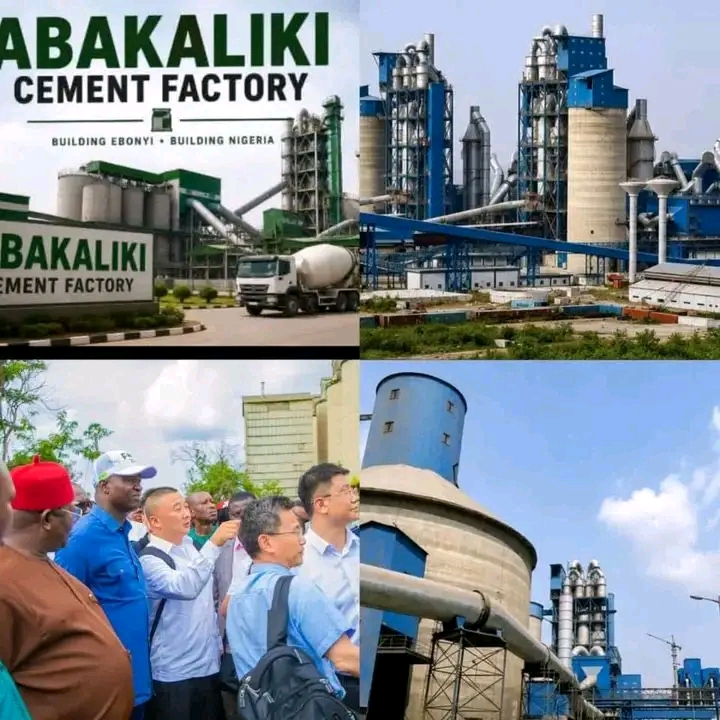
The proposed Abakaliki Cement Factory at Nkalagu in Ishielu Local Government Area is emerging as one of the major industrial projects being pursued by the Ebonyi State Government under Governor Francis Ogbonna Nwifuru’s People’s Charter of Needs.
The project is expected to provide a new industrial pathway for Nkalagu following the prolonged inactivity of the former Nigeria Cement Company (NIGERCEM), while positioning Ebonyi to take greater advantage of its abundant mineral resources.
Governor Nwifuru disclosed during an inspection of the moribund NIGERCEM facility with Chinese technical partners that preliminary assessments indicated about 50 million tonnes of limestone in Nkalagu and another 23 million tonnes in Effium, which, according to him, could sustain the proposed cement factory for a minimum of 30 years. The availability of limestone is particularly significant because it gives the proposed factory access to a major raw material within the state. Rather than merely extracting and transporting mineral resources out of Ebonyi, the project could enable the state to process its resources locally and create additional economic value through manufacturing.
One of the most immediate benefits of the proposed factory is expected to be employment creation. A modern cement plant would require engineers, technicians, machine operators, administrative workers, drivers, security personnel and other skilled and semi-skilled workers. Beyond direct employment, the factory could stimulate opportunities in transportation, logistics, maintenance, distribution, hospitality, trading and other support services.
The economic impact could also extend to the construction sector. Cement is a critical input for the development of roads, bridges, houses, schools, hospitals and other infrastructure. Increased local production could strengthen the supply chain and provide a more direct source of cement for Ebonyi and the wider South-East.
The Nigerian Investment Promotion Commission (NIPC) identifies Ebonyi as having some of the largest limestone deposits in the South-East and notes that the region currently obtains much of its cement supply from plants outside the region, including those in Ogun and Delta. The commission further identifies local cement production as an opportunity for Ebonyi to leverage its mineral resources and strengthen its industrial base. For Ebonyi, producing cement closer to the market could also help reduce some transportation and distribution pressures associated with bringing cement from distant production centres. This could have implications for the cost and availability of construction materials, although the actual effect on prices would ultimately depend on production costs, distribution networks, market conditions and other factors.
The project could equally broaden the state’s economic base through increased commercial activities, taxes, fees and other government revenues associated with a large-scale industrial operation. It could also encourage the emergence of businesses around the factory, including suppliers, transport operators, contractors, distributors and service providers.
Another significant aspect of the project is the involvement of Jiangsu Pengfei Group Ltd, a Chinese engineering company. In July 2026, the Ebonyi State Executive Council approved the design, construction and operation of a 6,000-tonnes-per-day Engineering, Procurement and Construction (EPC) cement plant at Nkalagu in partnership with the Chinese company. The state government also announced that a memorandum of understanding and agreement had been signed, with implementation processes subsequently underway. The partnership has the potential to provide access to specialised technical expertise and modern cement-manufacturing technology, while supporting the state government’s effort to attract external investment and technical capacity into Ebonyi.
The proposed plant is therefore not simply about constructing another factory. If successfully completed and commercially operated, it could create a wider industrial ecosystem connecting mining, manufacturing, transportation, construction, commerce and employment.
It also fits into the broader industrialisation agenda of the Nwifuru administration, which has been pursuing investment opportunities aimed at harnessing Ebonyi’s natural and human resources. The proposed cement project comes alongside other industrial initiatives being promoted by the state, including plans relating to iron and steel development and an industrial city.
For Nkalagu, the project could mark a significant transition from the era of a moribund industrial facility to a new generation of cement manufacturing. For Ebonyi, it represents an opportunity to convert its mineral endowment into industrial production, employment and economic activity.
With sustained implementation, appropriate technical standards, sound commercial management and the successful utilisation of its abundant raw materials, the proposed Abakaliki Cement Company could become an important pillar of Ebonyi’s long-term industrial development.